

Turkish Citizenship Benefits 2026: 11 Rights and Turkish Passport Visa-Free Countries
Turkish citizenship benefits for investors: the investor, the spouse and the children obtain citizenship in one application, keep their original nationality, live, work and own property in Türkiye as citizens, and travel on the Turkish passport.
Below are 11 benefits, each with a link to the official text it is based on, followed by what to know before applying, the list of Turkish passport visa-free countries, and the frequently asked questions.
These are the advantages of Turkish citizenship, including the rights of a Turkish citizen and the benefits of the Turkish passport. For the requirements, see Turkish citizenship by investment through real estate and Turkish citizenship by bank deposit.
1- Turkish citizenship benefits for the investor and family
Benefit 1: spouse and children in the same application. The law covers the investor, the foreign spouse, and the minor or dependent children of the investor and of the spouse. Dependent adult children are therefore included too, not only minors.
Source: Turkish Citizenship Law No. 5901, Article 12/1-b
Benefit 2: no prior years of residence. Ordinary naturalisation requires 5 years of continuous residence in Türkiye (Article 11). The investor obtains an investment residence permit and then applies for citizenship directly.
Source: Law on Foreigners and International Protection No. 6458, Article 31/1-j and Law No. 5901, Articles 11 and 12
Benefit 3: dual citizenship in Turkey is allowed. Turkish law permits multiple citizenship, and the civil registry records that the person holds more than one nationality.
Source: Law No. 5901, Article 44
2- Rights of a Turkish citizen: work and property
Benefit 4: work without a work permit. The International Labour Force Law regulates the work of foreigners in Türkiye and requires them to hold a work permit. A Turkish citizen is outside its scope and works like any other citizen.
Source: International Labour Force Law No. 6735
Benefit 5: professions reserved for Turkish citizens. The Ministry of Labour publishes a list of professions open only to citizens, including lawyer, dentist, pharmacist, veterinarian, notary, independent certified accountant and tourist guide. The professional requirements, such as the diploma and its recognition, still apply.
Source: Ministry of Labour and Social Security: professions reserved for Turkish citizens
Benefit 6: own property as a citizen. The limits on property ownership by foreigners in Article 35 of the Land Registry Law (area limit, share of foreigners in each district, military and security zones, list of countries) do not apply to Turkish citizens.
Source: Land Registry Law No. 2644, Article 35
3- Rights of a Turkish citizen: public services
Benefit 7: the right to vote and stand for election. Citizens have the right to vote, to be elected and to engage in political activity, under the conditions set by law.
Source: Constitution of the Republic of Türkiye, Article 67
Benefit 8: free primary education. Primary education is compulsory for all citizens and free in state schools.
Source: Constitution of the Republic of Türkiye, Article 42
Benefit 9: general health insurance. A citizen resident in Türkiye who has no health insurance in another country is covered by general health insurance (GSS). It is not free for everyone: the premium depends on income.
Source: Social Insurance and General Health Insurance Law No. 5510, Article 60
4- Turkish passport benefits and military service
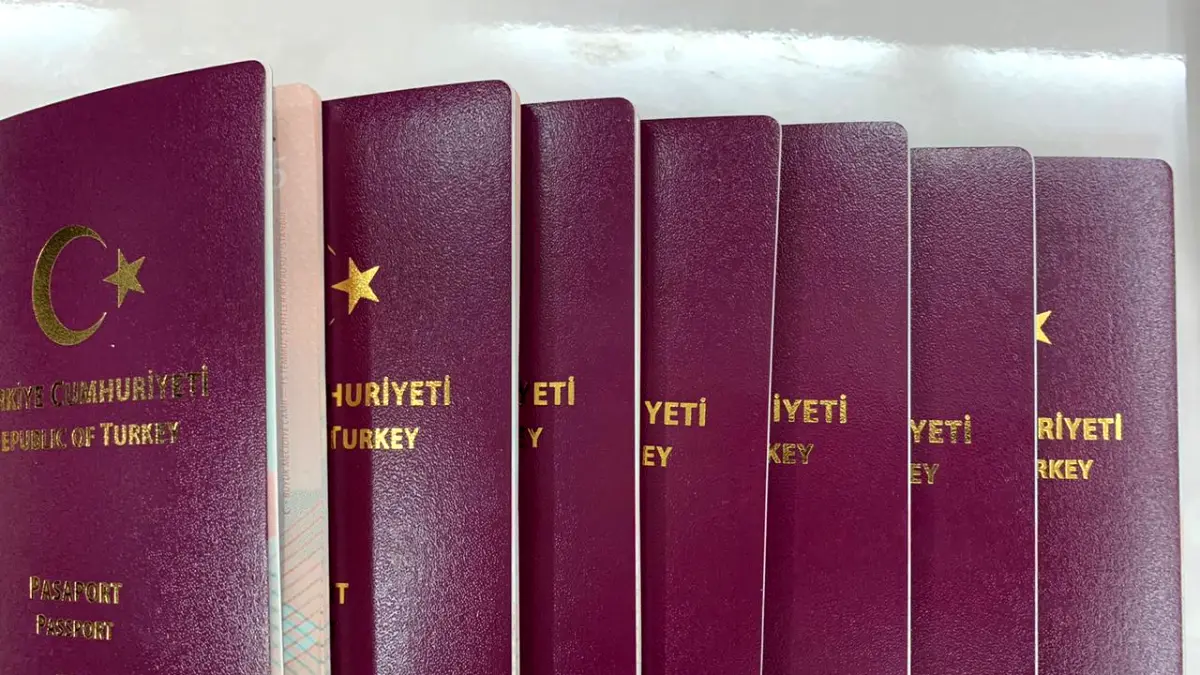
Benefit 10: travel on the Turkish passport. Many people ask about the strength of the Turkish passport and its ranking. Passport rankings change every few months, and for a traveller the official list is more accurate. Below are the Turkish passport visa-free countries for the ordinary (burgundy) passport, according to the list of the Turkish Ministry of Foreign Affairs as we reviewed it on 26 November 2026. The permitted length of stay differs by country and is stated in the official list.
Visa-free (68 countries and territories): Angola, Antigua and Barbuda, Argentina, Albania, Azerbaijan, Samoa, the Bahamas, Barbados, Belarus, Belize, Bolivia, Bosnia and Herzegovina, Botswana, Brazil, Brunei, Dominica, Ecuador, El Salvador, Indonesia, Morocco, Fiji, the Philippines, Guatemala, Georgia, Honduras, Hong Kong, Iran, Jamaica, Japan, Qatar, Kazakhstan, Kyrgyzstan, the Turkish Republic of Northern Cyprus, Colombia, South Korea, Kosovo, Costa Rica, North Macedonia, Lebanon, Macau, Mauritius, Mongolia, Moldova, Nicaragua, Oman, Uzbekistan, Palau, Panama, Paraguay, Peru, São Tomé and Príncipe, Saint Kitts and Nevis, Saint Lucia, Serbia, Seychelles (with prior online travel authorisation), Singapore, Chile, Thailand, Tonga, Trinidad and Tobago, Tunisia, Tuvalu, Ukraine, Uruguay, Jordan, Vanuatu, Venezuela, Zambia.
Visa on arrival (21 countries): Saudi Arabia (from the e-visa kiosks at the airport; not valid for Hajj), Kuwait, Egypt, Sudan, Syria, Somalia, Comoros, Cabo Verde, Timor-Leste, the Dominican Republic, Haiti (tourist card at the airport), Eswatini, South Africa, Tanzania, Namibia, Madagascar, the Maldives, Malaysia (free entry visa on arrival), Nepal, Cambodia, Liberia (at Monrovia airport, with conditions).
E-visa before travel (11 countries): Bahrain, Russia, Armenia, Djibouti, Kenya (electronic travel authorisation), Mexico (when travelling by air), Mauritania, Mozambique, Zimbabwe, Sri Lanka (free), Taiwan (free).
Special case: Iraq is visa-free only for travellers under 15 or over 50; others need a visa.
All other countries require a visa in advance from their embassy, including the Schengen countries, the United States, the United Kingdom and the UAE.
⚠️ Note: the list of countries is updated from time to time with each new agreement or decision, so check the official list before every trip.
Source: Turkish Ministry of Foreign Affairs: visa requirements for Turkish citizens
Benefit 11: aged 22 or over, military service counts as done. A person who acquires Turkish citizenship in a year in which they are 22 or older, or who proves military service in their previous country, is deemed to have completed military service. They may still be called up in a general mobilisation.
Source: Military Service Law No. 7179, Article 43
5- What to know before applying (disadvantages and obligations)
- Military service under 22: served according to age and education; it can be postponed for 2 years from the date of citizenship on request (Law 7179, Article 43).
- Your home country’s law: Türkiye allows dual citizenship, but some countries do not allow their citizens to hold another nationality. Check your country’s law before applying.
- 3-year no-sale rule: in citizenship through real estate, a 3-year no-sale annotation is placed on the title deed (Regulation on the Implementation of the Turkish Citizenship Law, Article 20).
- Presidential decision: citizenship by investment is granted by decision of the President, provided there is no security objection; it is not automatic once the investment is made (Law 5901, Article 12). The law sets no fixed processing time.
- Accurate information: if citizenship is obtained through false statements or by hiding a material fact, it is revoked, together with the spouse and children who acquired it through the applicant (Law 5901, Articles 31 and 32).
- US E-2 investor visa: Türkiye is on the US State Department list of treaty countries (travel.state.gov). However, since December 2022 US law requires those who obtained their citizenship through investment to have been domiciled in that country for at least 3 continuous years before applying for this visa (National Defense Authorization Act for Fiscal Year 2023).
6- Frequently asked questions about Turkish citizenship benefits
What are the benefits of Turkish citizenship?
The main ones: spouse and children in the same application, no prior years of residence, keeping your original nationality, working without a work permit, owning property, education and health insurance as a citizen, the right to vote, and travelling on the Turkish passport. Details and the source of each benefit are in the sections above.
How many countries can Turkish passport holders visit without a visa?
According to the list of the Turkish Ministry of Foreign Affairs as we reviewed it on 26 November 2026: 68 countries and territories visa-free, 21 countries with a visa on arrival and 11 countries with an e-visa before travel; the names are in the section on Turkish passport benefits above. The list is updated from time to time, so check the Ministry of Foreign Affairs website before travelling.
Does Turkey allow dual citizenship?
Yes. Turkish law does not require you to give up your nationality and allows multiple citizenship (Law 5901, Article 44). Some countries, however, do not allow their citizens to hold a second nationality, so check your country’s law.
Does Turkish citizenship include my spouse and children?
Yes. It covers the foreign spouse and the minor or dependent children of the investor and of the spouse (Law 5901, Article 12/1-b).
What is the difference between Turkish residence and Turkish citizenship?
A residence permit is temporary and renewable, and its holder remains a foreigner: they need a work permit, cannot vote and are subject to the limits on foreign property ownership. Citizenship is permanent and gives the full rights of a Turkish citizen.
What are the disadvantages or obligations of Turkish citizenship?
The main ones: military service for those under 22, the 3-year no-sale rule in the real estate route, and the possibility that your home country does not allow dual citizenship. Details are in the section “What to know before applying”.
Want to know which citizenship route suits you?
Read Turkish citizenship by investment, or talk to our consultants.
⚠️ The information here is taken from the official texts cited under each benefit, as of the review date shown on the page. Laws can change, so check the official source before any decision.